Sunday, 22 October 2017

Love After Life: Nobel-Winning Physicist Richard Feynman’s Extraordinary Letter to His Departed Wife

From Maria Popova's fabulous blog - Brain Pickings. 
www.brainpickings.org

Where the hard edge of physics meets the vulnerable metaphysics of the human heart.


Few people have enchanted the popular imagination with science more powerfully and lastingly than physicist Richard Feynman (May 11, 1918–February 15, 1988) — the “Great Explainer” with the uncommon gift for bridging the essence of science with the most human and humane dimensions of life.
Several months after Feynman’s death, while working on what would become Genius: The Life and Science of Richard Feynman (public library) — the masterly biography plumbing the wellspring of Feynman’s genius — James Gleick discovered something of arresting strangeness and splendor.
“My heart stopped,” Gleick tells me. “I have never had an experience like that as a biographer, before or since.”
In a mass of unread papers sent to him by Feynman’s widow, Gweneth, Gleick found a letter that discomposed his most central understanding of Feynman’s character. A generation after computing pioneer Alan Turing tussled with the binary code of body and spirit in the wake of loss, Feynman — a scientist perhaps uncommonly romanticyet resolutely rational and unsentimental in his reverence for the indomitable laws of physics that tend toward decay — penned a remarkable letter to a physical nonentity that was, for the future Nobel-winning physicist, the locus of an irrepressible metaphysical reality.
Richard Feynman as a youth
In high school, the teenage Richard spent summers at the beach in his native Far Rockaway. There, he grew besotted with a striking girl named Arline — a girl he knew he would marry. Both complement and counterpoint to his own nature, Arline met Richard’s inclination for science with ardor for philosophy and art. (The art class he took just to be near her would lay the foundation for his little-known, lifelong passion for drawing.) By his junior year, Richard proposed. Arline accepted. With the eyes of young love, they peered into a shared future of infinite possibility for bliss.
Richard and Arline, 1940s
But they were abruptly grounded when a mysterious malady began afflicting Arline with inexplicable symptoms — a lump would appear and disappear on her neck, fevers would roil over her with no apparent cause. Eventually, she was hospitalized for what was believed to be typhoid.
Gleick writes:
Feynman began to glimpse the special powerlessness that medical uncertainty can inflict on a scientific person. He had come to believe that the scientific way of thinking brought a measure of calmness and control in difficult situations — but not now.
Just as Feynman began bombarding the doctors with questions that steered them toward a closer approximation of the scientific method, Arline began to recover just as mysteriously and unpredictably as she had fallen ill. But the respite was only temporary. The symptoms returned, still shorn of a concrete explanation but now unambiguously pointing toward the terminal — a prognosis Arline’s doctors kept from her. Richard refused to go along with the deception — he and Arline had promised each other to face life with unremitting truthfulness — but he was forced to calibrate his commitment to circumstance.
Gleick writes:
His parents, Arline’s parents, and the doctors all urged him not to be so cruel as to tell a young woman she was dying. His sister, Joan, sobbing, told him he was stubborn and heartless. He broke down and bowed to tradition. In her room at Farmingdale Hospital, with her parents at her side, he confirmed that she had glandular fever. Meanwhile, he started carrying around a letter — a “goodbye love letter,” as he called it—that he planned to give her when she discovered the truth. He was sure she would never forgive the unforgivable lie.
He did not have long to wait. Soon after Arline returned home from the hospital she crept to the top of the stairs and overheard her mother weeping with a neighbor down in the kitchen. When she confronted Richard — his letter snug in his pocket — he told her the truth, handed her the letter, and asked her to marry him.
Arline and Richard, 1940s
Marriage, however, proved to be a towering practical problem — Princeton, where Feynman was now pursuing a Ph.D., threatened to withdraw the fellowships funding his graduate studies if he were to wed, for the university considered the emotional and pragmatic responsibilities of marriage a grave threat to academic discipline.
Just as Feynman began considering leaving Princeton, a diagnosis detonated the situation — Arline had contracted a rare form of tuberculosis, most likely from unpasteurized milk.
At first, Feynman was relieved that the grim alternative options of Hodgkin’s disease and incurable cancers like lymphoma had been ruled out. But he was underestimating, or perhaps misunderstanding, the gravity of tuberculosis — the very disease which had taken the love of Alan Turing’s life and which, during its two-century heyday, had claimed more lives around the globe than any other malady and all wars combined. At the time of Arline’s diagnosis in 1941, immunology was in its infancy, the antibiotic treatment of bacterial infections practically nonexistent, and the first successful medical application of penicillin a year away. Tuberculosis was a death sentence, even if it was a slow death with intervals of remission — a fact Richard and Arline faced with an ambivalent mix of brave lucidity and hope against hope.
Meanwhile, Richard’s parents met the prospect of his marriage with bristling dread. His mother, who believed he was marrying Arline out of pity rather than love, admonished him that he would be putting his health and his very life in danger, and coldly worried about how the stigma attached to tuberculosis would impact her brilliant young son’s reputation. “I was surprised to learn such a marriage is not unlawful,” she scoffed unfeelingly. “It ought to be.”
But Richard was buoyed by love — a love so large and luminous that he found himself singing aloud one day as he was arranging Arline’s transfer to a sanatorium. Determined to go through with the wedding, he wrote to his beloved:
I guess maybe it is like rolling off of a log — my heart is filled again & I’m choked with emotions — and love is so good & powerful — it’s worth preserving — I know nothing can separate us — we’ve stood the tests of time and our love is as glorious now as the day it was born — dearest riches have never made people great but love does it every day — we’re not little people — we’re giants … I know we both have a future ahead of us — with a world of happiness — now & forever.
On June 29, 1942, they promised each other eternity.
Richard and Arline on their wedding day
Gleick writes:
He borrowed a station wagon from a Princeton friend, outfitted it with mattresses for the journey, and picked up Arline in Cedarhurst. She walked down her father’s hand-poured concrete driveway wearing a white dress. They crossed New York Harbor on the Staten Island ferry — their honeymoon ship. They married in a city office on Staten Island, in the presence of neither family nor friends, their only witnesses two strangers called in from the next room. Fearful of contagion, Richard did not kiss her on the lips. After the ceremony he helped her slowly down the stairs, and onward they drove to Arline’s new home, a charity hospital in Browns Mills, New Jersey.
Meanwhile, WWII was reaching its crescendo of destruction, dragging America into the belly of death with the attack on Pearl Harbor. Now one of the nation’s most promising physicists, Feynman was recruited to work on what would become the Manhattan Project and soon joined the secret laboratory in Los Alamos.
Feynman’s Los Alamos badge
Arline entered the nearby Albuquerque sanatorium, from where she wrote him letters in code — for the sheer fun of it, because she knew how he cherished puzzles, but the correspondence alarmed the military censors at the laboratory’s Intelligence Office. Tasked with abating any breaches to the secrecy of the operation, they cautioned Feynman that coded messages were against the rules and demanded that his wife include a key in each letter to help them decipher it. This only amplified Arline’s sense of fun — she began cutting holes into her letters, covering passages with ink, and even mail-ordered a jigsaw puzzle kit with which to cut up the pages and completely confound the agents.
But the levity masked the underlying darkness which Richard and Arline tried so desperately to evade — Arline was dying. As her body failed, he steadied himself to her spirit:
You are a strong and beautiful woman. You are not always as strong as other times but it rises & falls like the flow of a mountain stream. I feel I am a reservoir for your strength — without you I would be empty and weak… I find it much harder these days to write these things to you.
In every single letter, he told her that he loved her. “I have a serious affliction: loving you forever,” he wrote.
Richard and Arline at the Albuquerque sanatorium
In early 1945, two and a half years into their marriage, Richard and Arline made love for the first time. He had been too afraid of harming her frail health somehow, she too afraid of infecting him with the deadly bacterium consuming her. But Arline insisted that this pent up desire could no longer be contained and assured Richard that this would only bring them closer — to each other, and to the life they had so lovingly dreamt up for themselves:
I’ll always be your sweetheart & first love — besides a devoted wife — we’ll be proud parents too… I am proud of you always Richard –[you are] a good husband, and lover, & well, coach, I’ll show you what I mean Sunday.
But heightened as their hopes were by this new dimension of shared experience, Arline’s health continued to plummet. Her weight dropped to eighty-four pounds. Exasperated by the helplessness of medicine, which Feynman had come to see not as a manifestation but as a mutilation of the scientific method, he invested all hope in an experimental drug made of mold growths. “Keep hanging on,” he exhorted Arline. “Nothing is certain. We lead a charmed life.” She began spitting blood.
At twenty-seven, on the precipice of a brilliant scientific career, he was terminally in love.
On June 16, 1945, while working at the computing room at Los Alamos, Feynman received a call from the sanatorium that Arline was dying. He borrowed a colleague’s car and sped to the hospital, where he found her immobile, her eyes barely tracing his movement. Early in his scientific career, he had been animated by the nature of time. Now, hours stretched and contracted as he sat at her deathbed, until one last small breath tolled the end at 9:21PM.
The wake of loss has a way of tranquilizing grief with the pressing demands of practical arrangements — a tranquilizer we take willingly, almost gratefully. The following morning, Feynman arranged for his beloved’s cremation, methodically collected her personal belongings, and on the final page of the small spiral notebook in which she recorded her symptoms he wrote with scientific remove: “June 16 — Death.”
And so we arrive at Gleick’s improbable discovery in that box of letters — improbable because of the extreme rationality with which Feynman hedged against even the slightest intimation of metaphysical conjectures untestable by science and unprovable by reason. During his courtship of Arline, he had been vexed by her enthusiasm for Descartes, whose “proof” of God’s perfection he found intellectually lazy and unbefitting of Descartes’s reputation as a champion of reason. He had impishly countered Arline’s insistence that there are two sides to everything by cutting a piece of paper and half-twisting it into a Möbius strip, the ends pasted together to render a surface with just one side.
Everything that appeared mystical, Feynman believed, was simply an insufficiently explained mystery with a physical answer not yet found. Even Arline’s dying hour had offered testing ground for conviction. Puzzlingly, the clock in the room had stopped at exactly 9:21PM — the time of death. Aware of how this bizarre occurrence could foment the mystical imagination in unscientific minds, Feynman reasoned for an explanation. Remembering that he had repaired the clock multiple times over the course of Arline’s stay at the sanatorium, he realized that the instrument’s unwieldy mechanism must have choked when the nurse picked it up in the low evening light to see and record the time.
How astonishing and how touchingly human, then, that Feynman penned the letter Gleick found in the box forty-two years later — a letter he wrote to Arline in October of 1946, 488 days after her death:
D’Arline,
I adore you, sweetheart.
I know how much you like to hear that — but I don’t only write it because you like it — I write it because it makes me warm all over inside to write it to you.
It is such a terribly long time since I last wrote to you — almost two years but I know you’ll excuse me because you understand how I am, stubborn and realistic; and I thought there was no sense to writing.
But now I know my darling wife that it is right to do what I have delayed in doing, and that I have done so much in the past. I want to tell you I love you. I want to love you. I always will love you.
I find it hard to understand in my mind what it means to love you after you are dead — but I still want to comfort and take care of you — and I want you to love me and care for me. I want to have problems to discuss with you — I want to do little projects with you. I never thought until just now that we can do that. What should we do. We started to learn to make clothes together — or learn Chinese — or getting a movie projector. Can’t I do something now? No. I am alone without you and you were the “idea-woman” and general instigator of all our wild adventures.
When you were sick you worried because you could not give me something that you wanted to and thought I needed. You needn’t have worried. Just as I told you then there was no real need because I loved you in so many ways so much. And now it is clearly even more true — you can give me nothing now yet I love you so that you stand in my way of loving anyone else — but I want you to stand there. You, dead, are so much better than anyone else alive.
I know you will assure me that I am foolish and that you want me to have full happiness and don’t want to be in my way. I’ll bet you are surprised that I don’t even have a girlfriend (except you, sweetheart) after two years. But you can’t help it, darling, nor can I — I don’t understand it, for I have met many girls and very nice ones and I don’t want to remain alone — but in two or three meetings they all seem ashes. You only are left to me. You are real.
My darling wife, I do adore you.
I love my wife. My wife is dead.
Rich.
And then, with the sole defibrillator for heartache we have — humor — Feynman adds:
PS Please excuse my not mailing this — but I don’t know your new address.
Complement this particular portion of the altogether magnificent Genius: The Life and Science of Richard Feynman with Rachel Carson’s stunning deathbed farewell to her beloved and Seneca on resilience in the face of loss, then revisit Feynman on science and religion and the meaning of life.

Friday, 20 October 2017

Finding your mission.


Alain de Botton's beautifully clear video explains the difference between a Mission and an Ambition and also explains why we need to have a clear "Mission" in our lives. 


Missions are plans that allow us to focus on the direction we want. Probably the more "ambitious" the better. 

One of the main problems for most of us is getting distracted with multiple plans and interests, and losing direction. De Botton explains how a Mission can help us to focus on what is important.

Having direction and a clear goal in front of you has obvious advantages. Firstly in terms of pushing aside everything that doesn't meet that direction and secondly in giving our lives purpose and meaning. 

To state the obvious, we are more likely to get where we want to go if we focus on where it is we want to go.

Thursday, 12 October 2017

The psychology of colour


Colour, like music is visceral. It's something you feel rather than intellectually understand.
Whilst I agree with a lot of the analysis below, I have to say that it's not the right way to experience colour. It's fun to understand what the effect is, or might be, but the essence of colours effect on us is to experience it, not to analyse it.


Monday, 2 October 2017

Your Elusive Creative Genius

"Eat, Pray, Love" author Elizabeth Gilbert muses on the impossible things we expect from artists and geniuses -- and shares the radical idea that, instead of the rare person "being" a genius, all of us "have" a genius. It's a funny, personal and surprisingly moving talk.


Gilbert explores the difficult to grasp thought of where ideas come from. Good ideas often seem like little fragments, transients ideas that come from somewhere outside of us, and that in the right state of mind we can capture an idea as it passes on it's journey. We just happen to be in the way and, sometimes, in the right state of mind to receive.

Of course that's not how it happens, there is no genie to let out of the bottle. 
I don't, and nor does Gilbert, agree that ideas come from outside us, but we seem need a "second" voice, that seems to be outside us, so, as in all good storytelling, we make it up. We find a way to visualise a process we don't fully understand.

The reality is you just have to show up for the job. As Gilbert says, be stubborn, keep at it. you can't wait for inspiration to come to you, you have to get yourself into the right mindset and do the work. In some ways it's a numbers game. The more you turn up, the more chance you have of getting the result you want.

But just turning up isn't enough, you need to get into the right mind state too. This is what Mihaly Csikszentmihalyi  calls "flow". That playful state of mind where relaxation and concentration meet, where time passes unnoticed. A bit like a trance. Perhaps that's why we allocate this feeling to something outside us, like God. It's easier to think of creativity as coming from outside of you, and perhaps visualising it this way helps to get into the right mindset. It's difficult to believe that creativity comes from you, it's easier to think it comes from a force outside. Whatever helps to make it happen is worthwhile.

But Gilbert's advice is right "Do your job...show up. be stubborn".


Sunday, 24 September 2017

5 Triggers That make new Habits Stick

I am indebted to James Clear for this insightful article.

In his best-selling book, The Power of Habit (audiobook), author Charles Duhigg explains a simple three-step process that all habits follow. This cycle, known as The Habit Loop, says that each habit consists of…
  1.   The Trigger: the event that starts the habit.
  2.  The Routine: the behavior that you perform, the habit itself.
  3. The Reward: the benefit that is associated with the behavior.

The image below shows how these three factors work together to build new habits. 


Each phase of the loop is important for building new habits, but today I’d like to discuss the first factor: habit triggers.
There are five primary ways that a new habit can be triggered. If you understand each of them, then you can select the right one for the particular habit that you are working on.
Before we talk about how to get started, I wanted to let you know I researched and compiled science-backed ways to stick to good habits and stop procrastinating.
Here’s what you need to know about each trigger…

Trigger 1: Time
Time is perhaps the most common way to trigger a new habit. Common morning habits are just one example. Waking up in the morning usually triggers a cascade of habits: go to the bathroom, take a shower, brush your teeth, get dressed, make a cup of coffee, etc.
There are also less commonly recognized ways that time triggers our behavior. For example, if you pay attention you may notice that you repeat certain tasks mindlessly at different points during the day: heading off to get a snack at the same time each afternoon, taking a smoking break at the same time each morning, and so on.
If these patterns are bad habits, then you may want to take stock of how you feel at this time of day. In many cases, your habits are a signal of how you feel. Bored? Maybe your afternoon snacking habit is a way of breaking up the monotony of the day. Feeling lonely? Maybe your smoking break is a way to connect with fellow co-workers. The point is, if you understand the reason why these habits pop up at the same time each day, then it can become easier to find a new habit to fill the void. Bad habits are replaced, not eliminated.
How I use it: Time-based triggers can also be used to stick with routines over and over again. This is my preferred method. For example, every Monday and Thursday I write a new article and post it on JamesClear.com. The time and date drive this pattern. It doesn’t matter how good or how bad I feel about the article. It doesn’t matter how long or how short the article is. All that matters is that I stick to the schedule. The time triggers the habit.
Trigger 2: Location
If you have ever walked into your kitchen, seen a plate of cookies on the counter, and eaten them just because they are there in front of you, then you understand the power of location on our behavior.
In my opinion, location (i.e. environment) is the most powerful driver of mindless habits and also the least recognized. In many cases, our habits and behaviors are simply a response to the environment that surrounds us. The famous study on water versus soft drink consumption is one example of how our environment can either promote good habits or lead us toward bad ones.
However, location-based triggers are not simply things we respond to, they can also be things we create. Multiple research studies by David Neal and Wendy Wood from Duke University have discovered that new habits are actually easier to perform in new locations.
One theory is that we mentally assign habits to a particular location. This means that all of the current places that you’re familiar with (your home, your office, etc.) already have behaviors, habits and routines assigned to them. If you want to build new habits in these familiar locations, then you need to overcome the triggers and cues that your brain has already assigned to that area. Meanwhile, building a new habit in a new location is like having a blank slate. You don’t have to overcome any pre-existing triggers.
How I use it: When I arrive at the gym, I head to the same spot each time to get ready, change into my lifting gear, and start my warm up. This location in the gym is a simple trigger that helps prompt my pre-workout routine (more on the power of a pre-game routine). There are bound to be some days when I don’t feel like exercising, but the location-based trigger helps me overcome that and get into my workout ritual as painlessly as possible.
Trigger 3: Preceding Event
Many habits are a response to something else that happens in your life. Your phone buzzes, so you pick it up to check your latest text message. The little notification bar lights up on Facebook, so you click it to see what it signals. These are examples of habits that are triggered by a preceding event.
When it comes to triggers that are useful for building new habits, I find preceding events to be one of the most useful. Once you understand habit stacking you can develop all sorts of ways to tie new habits into preceding events. (Example: “When I make my morning cup of coffee, I will meditate for one minute.”)
How I use it: For over two years, I have used a preceding event to stick with a daily gratitude habit. Each night, when I sit down to eat dinner, I say one thing that I was grateful for that day. (It’s worth noting, one reason I believe I have been able to stick with this habit so consistently is because it is so small. The smaller the habit, the easier it is to build into your life.)
Trigger 4: Emotional State
In my experience, emotional state is a common trigger for bad habits. For example, you may have a habit of eating when you feel depressed. Or, you may default to online shopping when you feel bored. The emotional states of depression or boredom are triggers for these negative habits.
Unfortunately, although emotions are very common triggers for our behavior, I find that they are harder to control and utilize for building good habits. Mostly, I think this is because if you want an emotion to trigger a positive habit, then you often need to be consciously aware of the emotion as you are experiencing it. In other words, you have to be emotional and aware at the same time … and that can be hard to do. Paying attention is a powerful, but difficult, way to build better habits.
How I use it: I’m trying to get better about noticing when I am holding tension in my body and experiencing stress. When I do notice that I’m feeling particularly stressed, I’ll use this emotional state to trigger a deep breathing habit.
I like to follow a 3-1-5 breathing pattern: three seconds in, pause for one second, five seconds out. I’ll usually repeat this sequence three to five times. I find this little breathing exercise to be a great instant stress reliever. It’s particularly useful because you can literally do it anywhere.
Trigger 5: Other People
It is probably no surprise to you that the people you surround yourself with can play a role on your habits and behaviors. What may be a surprise is just how big of an impact these people can make. One study in the New England Journal of Medicine found that if your friend becomes obese, then your risk of obesity increases by 57 percent — even if your friend lives hundreds of miles away.
As far as I can tell, the best way to make use of this information is to surround yourself with people who have the habits you want to have yourself. As Jim Rohn says, “You are the average of the five people you spend the most time with.”
How I use it: I'm not a heavy drinker, but nearly every time I go out with friends I get a drink. Why is that? If I'm not yearning for a beer, why get one? It’s simply a response to the environment that I am in and the people I am around. 
Before You Choose Your Trigger
No matter what trigger you choose for your new habit, there is one important thing to understand. The key is to choosing a successful trigger is to pick a trigger that is very specific and immediately actionable.
For example, let’s say you want to build a new habit of doing 10 pushups each day at lunch time. You might start by choosing a time-based trigger and saying something like, “During my lunch break each day, I’ll do 10 pushups.” This might work, but it's not very specific. Do you do your pushups at the beginning of your lunch break? At the end? Any time?
Alternatively, you could create a trigger around a very specific preceding event that happens right around your lunch break. For example, “When I close my laptop to leave for lunch, I’ll do 10 pushups.” In this case, the very specific action of “closing the laptop” is a perfect trigger for what to do next (your 10 pushups). There is no mistaking when you should do the new habit.
As always, self-experimentation is the only real answer. Play around with these five habit triggers and see what works for you.


By James Clear   

Sunday, 17 September 2017

It's the feeling that counts


Once upon a time we were happy with our consumer economy, comfortable in the knowledge that what we consumed, stated who we were and defined our position in society. Simple, easy and clear. You knew what you could afford and aspired to move a little further up the social ladder, defined by what you consumed.

Then came “Branding”, the awareness that we could better define who we were by the products we used and the stories they told. We could belong to smaller groups that weren’t socially or ethnically differentiated. That was the consumer economy and the service economy.

Our hopes, desires and aspirations could be targeted and exploited by our desire to belong, to be part of something. The stories brands carried with them bound us together in loyal groups, until consumption became the empty promise of a better life.

Emotion has always been present in consumption, but the realisation that experience is the result emotion and is how we “feel” things, has allowed experience to become the driving force behind contemporary design and economic theory, and so we have the so-called “experience economy”.
The concept was first outlined by Alvin Toffler in his book, Future Shock and was brought into economic and consumer theory by Pine and Gilmore in their 1998 Harvard article. They felt that all consumption can be understood in experiential terms. Building brand value becomes building the stories and collective experiences that we want to share. People will be willing to invest very high percentages of their salaries to live amazing experiences.

Loyalty to a brand is only as strong as the emotions it evokes and the experiences that can be shared. Technology has made this even more evident, as we share the picture of the experience rather than enjoying the experience itself and for its own sake. I don’t think hotels can count on loyalty anymore unless they can deliver collective experiences. Transformational experiences.

So perhaps what we have now is the “transformational economy”. We consume experiences in the same way we consume a theme park experience, always on to the next, more thrilling experience. People are fickle and will switch loyalty for the next experience. It’s a buyer’s market, in hospitality, in fashion, in holidays, in telephones, and almost any other market.

So, is there any place for traditional values such as Authenticity, Service, Glamour, Beauty, Good Design?

Perhaps only if these qualities can deliver a transformational, shareable, emotional experience. Brand values are only as good as the experience they are able to deliver. So, I believe that all the above qualities are only marketable if they can deliver the experience.

On one level Brand loyalty is the reduction of risk, on both sides. You tell me something I value and buy into and I’ll give you my affiliation, affection and trust, we share values and stories and we can believe that we have mutual interests. You are consistent and I feel we are compatible. So, we play a little game, you think you understand my needs and I think you deliver what I want. But if I am fickle and change my desires, will I remain loyal. No. My loyalty depends on my needs not yours. In a very distracting world, with short spans of attention, I will only be loyal if you can change in harmony with me and deliver the values I now hold.

I think it is rare for Brands to be loyal to their customers, because to be loyal they must reverse their role, as object and become subject. Brands can show loyalty to their customers by listening and changing. Consumer research is often focussed on the lowest common denominator. It does give the customer what they want, and it reduces risk for the brand, but it rarely innovates. Technology engagement isn’t the answer, the answer is the question; what problem, need or desire does this solve? If and only if, it enhances the experience, then it has value. And the game is to add value to the experience.


In an experience economy, it seems to me, a brand would need to be perceived to be constantly evolving and innovating as a core quality of its brand. In fact, I think that is the new experiential brand. Not product based but innovation based, change based. It’s a risky business. That’s why people will change hotels according to their changing needs and means, rather than remaining loyal to one brand.

I think hotels are right to diversify and segment their brands into ever smaller niche markets at the moment. That’s how we consume now. If a group can deliver 20 evolving brands and keep its sanity whilst others around it are losing theirs, they will succeed. I don’t think the future is in better technology (unless it enhances the experience), the future is in ever smaller niche brands, that deliver unique and diverse experiences. Perhaps within an overarching “trusted” group. But in order to deliver, they will need to keep innovating. The fickle guest constantly reviews the landscape and changes his or her mind as to where to spend their money.

Loyalty isn’t a thing of the past, but it is changing and it’s changing in favour of fleeting, momentary experiences that can be shared. The future’s bright, but it’s not orange, more like 50 shades of grey.


CL 15/09/2017

Sunday, 3 September 2017

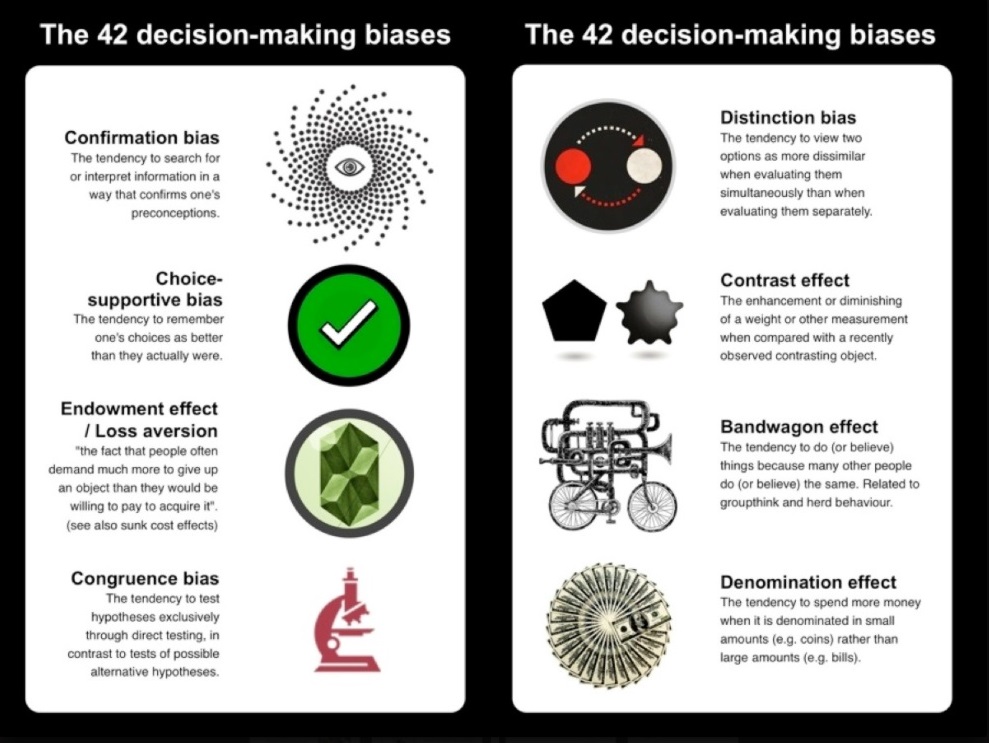
Cognitive Biases


cognitive bias refers to the systematic pattern of deviation from norm or rationality in judgment, whereby inferences about other people and situations may be drawn in an illogical fashion. 


A continually evolving list of cognitive biases has been identified over the last six decades of research on human judgment and decision-making in cognitive sciencesocial psychology, and behavioral economics. Kahneman and Tversky (1996) argue that cognitive biases have efficient practical implications for areas including clinical judgment, entrepreneurship, finance, and management.


Individuals create their own "subjective social reality" from their perception of the input. An individual's construction of social reality, not the objective input, may dictate their behavior in the social world. Thus, cognitive biases may sometimes lead to perceptual distortion, inaccurate judgment, illogical interpretation, or what is broadly called irrationality.


Cognitive biases may lead to more effective actions in a given context. Furthermore, cognitive biases enable faster decisions when timeliness is more valuable than accuracy, as illustrated in heuristics. Other cognitive biases are a "by-product" of human processing limitations, resulting from a lack of appropriate mental mechanisms (bounded rationality), or simply from a limited capacity for information processing.


Cognitive Bias arises from various processes that are sometimes difficult to distinguish. These include
  • information-processing shortcuts (heuristics)
  • noisy information processing (distortions in the process of storage in and retrieval from memory)
  • the brain's limited information processing capacity
  • emotional and moral motivations


Creatives are intuitively aware of our cognitive biases and will often use these predilections, albeit without necessarily being aware of what they are called, to influence and manipulate the emotional, cultural and behavioral responses of their audiences. The ability to design (or craft a future) is often the ability to empathize with and identify with the audience, in the same way as an actor will approach a role by identifying the motivations of the character.

CL Sept 2017 


First Principles

First Principles: Elon Musk on the Power of Thinking for Yourself   First principles thinking, which is sometimes called reasoning fr...